
Chyandour Square, Penzance
(Google Streetview 2021)
"Has anyone got any information and/or images of Chyandour to share?"
- Paul Mason at buryanpaul@yahoo.com
Chyandour: East of Penzance
by Paul Mason
Gateway to Penzance and beyond
Visitors to Penzance arriving from 'upcountry' almost invariably
enter town on the eastern side, either by the A30 road or by train,
where they get a brief glimpse of Chyandour, a little village on the
outskirts of town.
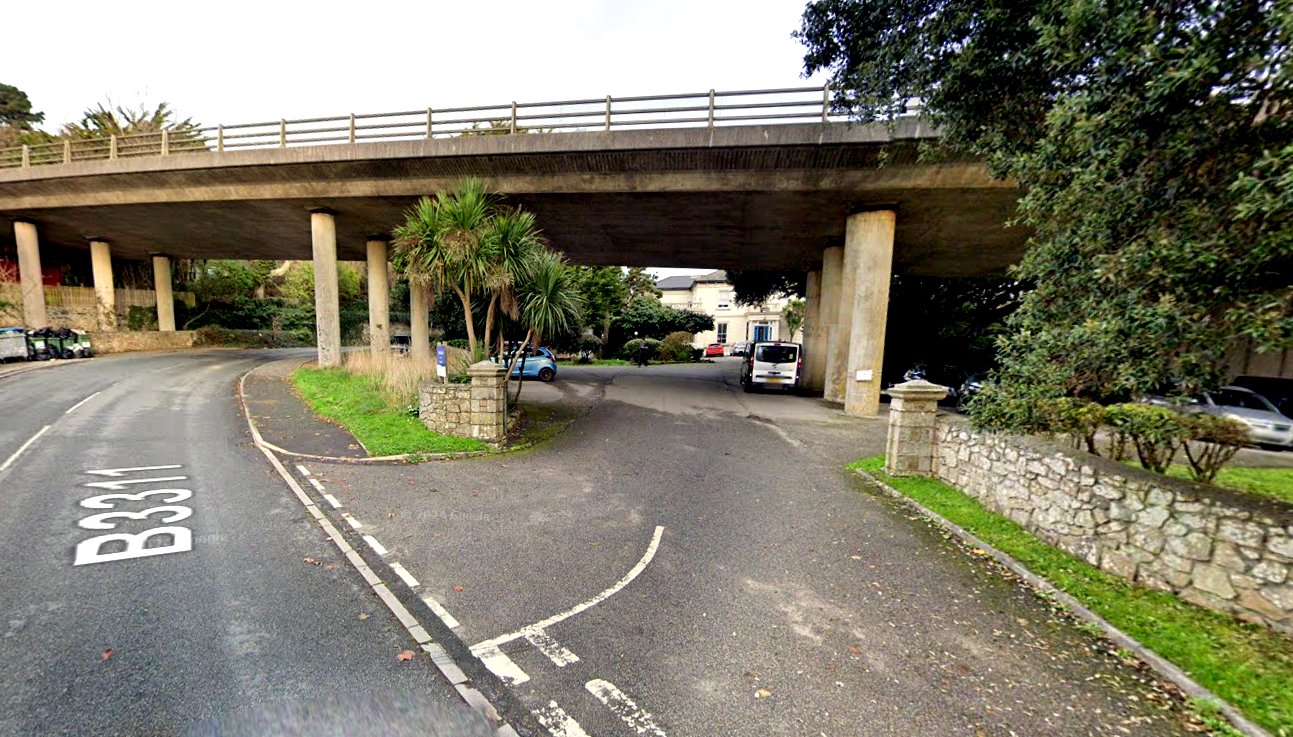
Chyandour Square, Penzance
(Google Streetview 2021)
Way back in time, in 1404, Penzance was granted a market charter to enable it to be a 'market-town', meaning it was entitled to hold a weekly market. Later, in 1614, the town gained the status of a Municipal Borough, essentially meaning Penzance could be self-governing, the borough being a circle of land with a radius of roughly 1/2 mile centred on the Market Cross at Greenmarket and bounded by four boundary stones at the points of the compass, the northern one being at St Clare, the western one being in Alverton, the southern in Wherrytown, and the eastern one at Chyandour Cliff, a stone, inscribed on three faces, the one closest to town having the letter 'P' (short for Penzance), the facet facing out showing '16', and the third side showing '87' (thus signifying the year as 1687).
Today the eastern boundary stone stands on the pavement in front of number 8 Chyandour Cliff, next door to Royale Court (formerly Hotel Royale), though in 1687 it most likely stood on the corner of the lane next to 20 Chyandour Cliff, where, according to Dawson's Parish Map, the boundary then was. Interestingly, this demarcation line placed Lescudjack, the ancient fortress on the brow of Chyandour Cliff, and the village of Chyandour outside the borough limits.

Ordnance Survey map 1809
Chyandour shown as Chyandower
The name Chyandour (or Chyandower) is Cornish and means 'House by the Stream' - with 'chy' meaning 'house', 'an' meaning 'the', and both 'dower' and 'dour' meaning 'stream or water'.
Chyandour is an old established village that sits beside the Chyandour Brook, a stream which runs down the picturesque Chyandour Coombe from Madron and Treneere.
Though the village is nowadays predominantly residential, a century or so ago Chyandour was a thriving industrial area and profitable too, with one family in particular benefitting - the Bolithos - who moved to the Penzance area in about 1760.
'The Bolithos are truly Cornish: early records of the family are derived from Wendron, Helston, Penryn, Launceston and Liskeard.'
Portrait of Thomas Bolitho (1765–1858)
(copy of oil painting by anonymous artist)
In 1802 Thomas Bolitho (1765-1858) the son of a tanner, married Maria Harris (1781-1853)
and became father to three sons, Edward (1804-1890), Thomas Simon
(1808-1887), and William (1815-1895), and six daughters, Mary,
Elizabeth, Maria, Frances, Emily and Catherine.
https://ancestors.familysearch.org/en/KHLW-GTL/thomas-bolitho-1765-1858
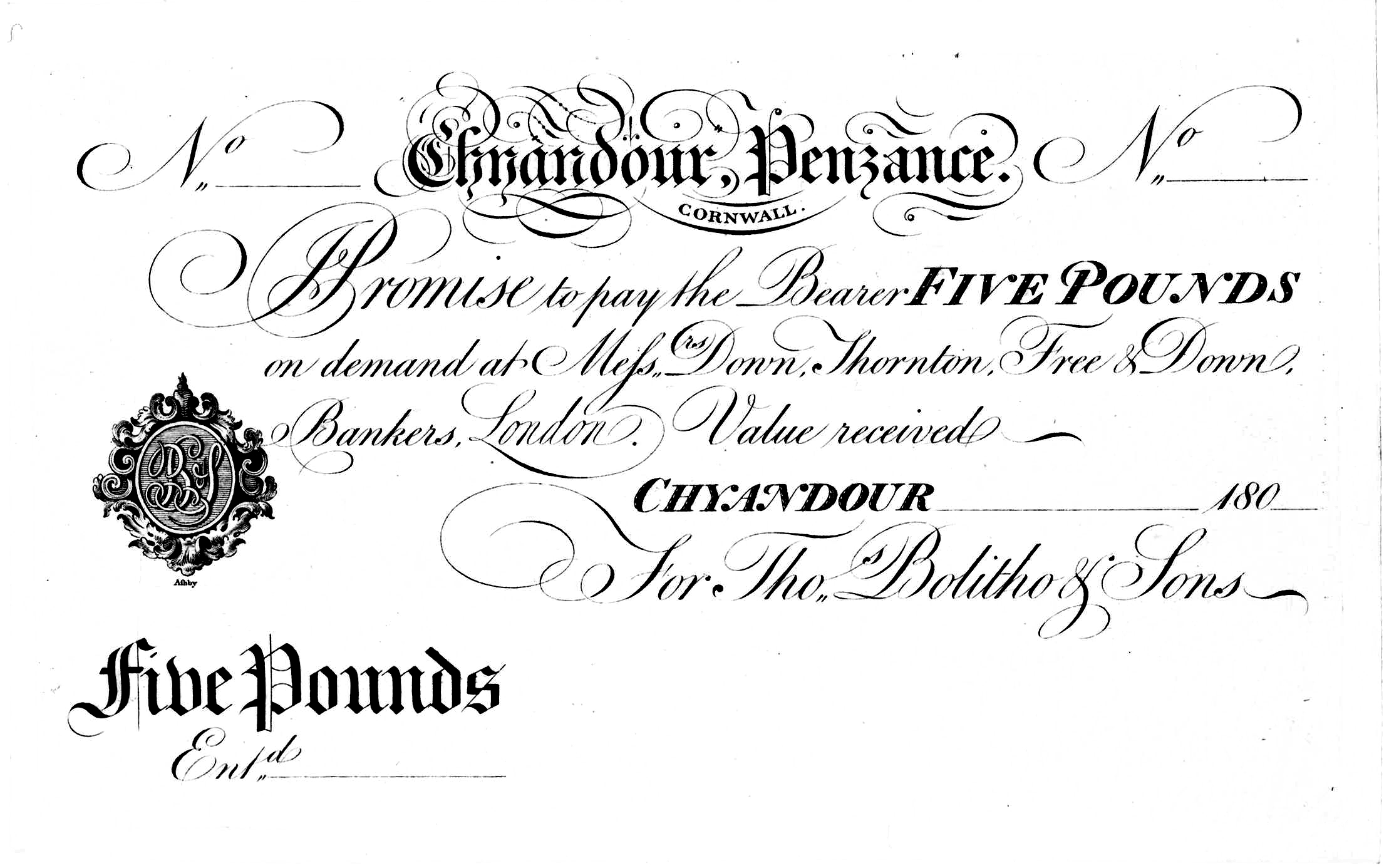
'MOUNT'S
BAY COMMERCIAL BANK established at Chyandour in 1807 by Thomas Bolitho
(The Coombe) and William Bolitho (Gulval), merchants.
Renamed BOLITHO, SONS & CO. 1810;'
https://www.gracesguide.co.uk/Messrs._Bolitho
Officially, Chyandour lay beyond the boundary with Penzance and was therefore not subject to local taxes and duties. Chyandour was close enough to have a clear view of Penzance but sufficiently far away to have an identity of its own.
According to the Pigot Directory of Cornwall of 1823, there were but two businesses being carried out in Chyandour:
'TAVERNS AND PUBLIC HOUSES. Copper Tin & Fish, Wm. Weymouth, Chyandour., Three Tuns, Thos. Smith, Chyandour'
But that would be to overlook the Bolitho family, who lived and worked in Chyandour, and are also listed as having multiple business interests:
'BANKERS. Bolitho, Sons & Co.
MERCHANTS. Bolitho Thos & Sons,
SHIP OWNERS. Bolitho Thos. & Wm
TANNERS. Bolitho & Co.
TIN SMELTERS. Bolitho & Co.'
http://west-penwith.org.uk/pigot23.htm#penzance
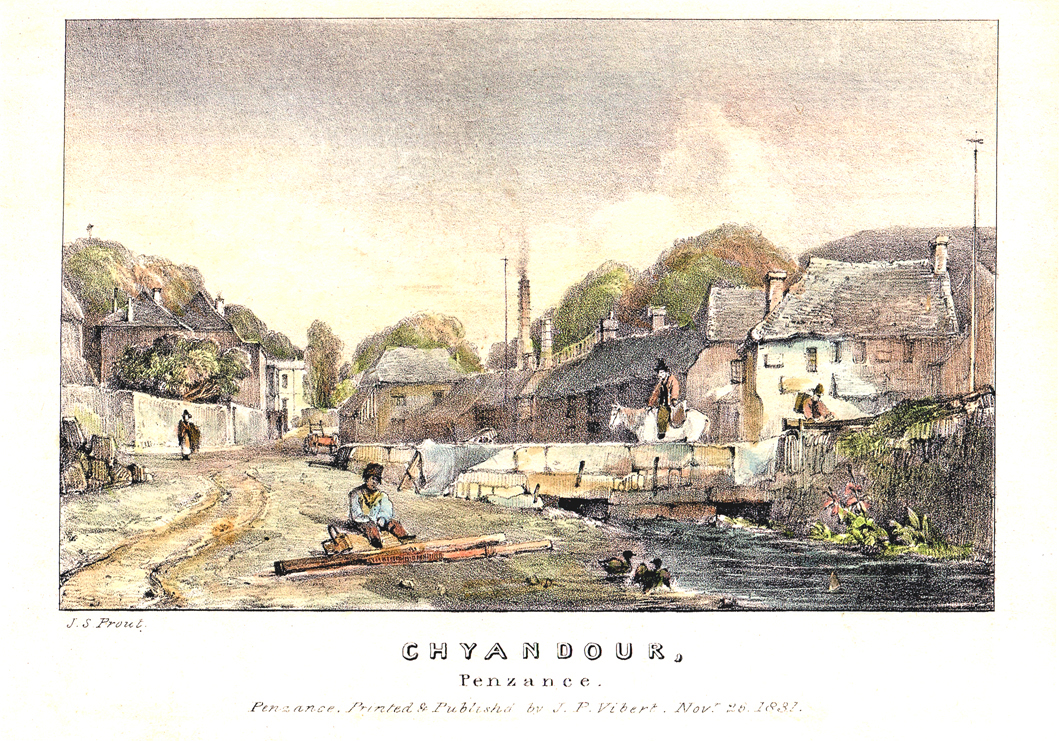
Unfortunately though, it seems the local workers in Chyandour lived in poor conditions back then.
'In
1825, and for many years after, the houses at Chyandour were very small
and dilapidated. The two large houses now occupied by Mrs. Trevithick
and Mr. Milton were built about this time; the granite house next to
Mrs. Trevithick’s was for many years one of the best lodging
houses in this neighbourhood. On the other side of the road opposite
the granite house was a good-sized garden [locally, in those days, the word 'garden' more often than not meant 'allotment'], now taken away to make room
for the railway. Between these houses and Penzance were on the right
hand fields, and on the left a hedge; seaward of the hedge the ground
sloped down to the beach.'
http://west-penwith.org.uk/pz1.htm



Contained in the Coulson's Directory of 1862 is a listing of local residents and their trades:
'Chyandour Cliff.
Edwin Sherman Polkinghorne, Esq., Francis Trevithick, Esq., John
Berryman, Coachman., Mrs. Thornton., Jacob Corin., Barzillai Beckerleg,
Mastermariner., Mrs. Griffen., Richard Hall, Labourer., Mrs. Trounson.,
Charles Ladner, Shoemaker., William Hitchens, Labourer., John Perry, W.
C. R. [West Cornwall Railway],
James Kingston Stevens, Basket-maker., Miss Barnicoat., George Brewer,
Labourer., Thomas Hall, Tin-smelter., Richard Roliston, Butler., John
Harris, Engineman W. C. R., Mrs. Penrose., Miss Mann, Needlewoman.,
Samuel Hocking, Labourer., James Bennetts, Guard W. C. R., Michael
Perryman, Shopkeeper., Mrs. Eathorne., John Allan, Labourer., John
Richards, Guard W. C. R., William Gilbert, Shopkeeper., John Escott,
Guard W. C. R., John Tucker, Labourer., William Pengelly,
Basket-maker., William Uren, Labourer., Mrs. Hicks., William Oliver,
Labourer., Richard Martins, Labourer.,
Mrs. Rogers., William Rowe, Labourer., Miss Baragwaneth., James Couch,
Shoemaker., Richard Hall, Labourer., John Lovell, Tanner., William
Matthews, Labourer., Richard Denithorne, Tanner., James Trewern, Tanner., James Denithorne, Labourer., Samuel Ridgeman, Labourer., Richard Denithorne, Labourer.
Chyandour.
James Denithorne, Tanner., Peter Ley, Tanner.,
William Rundle King, Innkeeper., Mrs. Friggens, Shopkeeper., George
Pellew, Labourer., Mrs. Jeffery., John Bridgeman, Labourer., Charles
Rowe, Labourer., William Bridgeman, Labourer., John Edwards, Labourer., James Trewhella, Labourer., Richard Mildrum, Labourer., Frederick William West, Sergeant C. C. C. [Cornwall County Constabulary], James Lovell, Tin-smelter., William Matthews, Tanner., Richard Hocking, Tanner., Edward Hocking, Tanner., William Jenkin, Tin-smelter., Richard Mann, Tin-smelter.,
William Tredrea, Innkeeper., William Barnicoat, Tanner., Thomas
Matthews, Tin-smelter., David Eddy, Labourer., James Ferrell, Hind [servant]., John Squance, Coachman., Richard Marrack, Accountant.
Chyandour Terrace.
1. William Bottrell, Carrier., 2. James Curtis, Coachman., 3. James Rowe, Tin-smelter., 4. Nicholas White, Blacksmith.'
http://west-penwith.org.uk/coulson2.htm#C


Tanning Barn, Chyandour Coombe
(Google Streetview July 2023)
Tin Smelting in Chyandour
Back in around 1660 John Tremenheere (1628-1685), Mayor of Penzance in 1655 and 1665, set up a tin smelting works at Chyandour.
'John Tremenheere, known in his family as John the first, was elected mayor at the age of twenty-seven. He had been a prominent Royalist and taken part in the Penzance rising in 1648, but had kept out of serious trouble. In 1662, he helped the corporation to entertain Catherine of Braganza, Charles II's queen, as she made landfall in Penzance and was given the town's hospitality (to the recorded expense of £7 2s 11d). Anticipating Penzance's stannery, he had added to his many business interests by setting up Penwith's only smelting works, just outside the borough boundary at Chyandour. This was a speculation only available to the wealthy due to the high price of coal and the diffulty and danger of importing it, but it was most successful and became one of the most important smelting houses in Cornwall.'
- 'Penzance: The Biography' by Michael Sagar-Fenton, Amberley Stroud 2015
A few words are needed to explain what tin smelting is:
'Tin
mines do not produce tin metal, they mine ore and process it into tin
concentrate which then has to be smelted to produce the tin metal. The
smelters set up their works around the coinage towns for convenience
and for the efficient regulation and taxation of the trade.'
https://www.penwithlocalhistorygroup.co.uk/on-this-day/?id=201
Up until 1663 the ore from the Penwith area was taken to Helston, a distance of over 14 miles (an inconvenient and costly journey), then Penzance became a 'coinage' town, that is to say:
'Coinage was essentially a tax on tin. The mechanism for gathering the tax involved sampling, or coining, smelted blocks of tin, the samples were assayed, the block weighed and the dues calculated. Once the dues had been paid the block was stamped with the Duchy seal and only after this could the tin be sold. In order to run an efficient tax collection system the coinage operation was centralised, all tin had to be taken to a coinage town to be coined and the town where it was taxed became the place where it was also sold. These blocks of tin weighed about 300 pounds (136 kilos) so transporting them around the county was not a very viable option.'
https://www.penwithlocalhistorygroup.co.uk/on-this-day/?id=201So, shortly after Tremenheere started his tin smelting operation, Penzance became a 'Stannary Town'.
'All
tin that had been mined and made into blocks was taken to a Stannary
Town where it was weighed and the coinage tax was paid. This happened
four times a year, at Lady Day (25th March) midsummer, Michaelmas (29th
September) and Christmas. On the coinage day, officials would weigh the
tin and test its quality by taking a corner from each block. This
process was called ‘coining’, and is where we get the word coinage. If
the tin was of good quality it would be stamped with the Duchy of
Cornwall’s official stamp.'
https://www.cornwallforever.co.uk/history/cornish-stannaries
When John Tremenheere died in 1685 he not only willed his many properties and possessions, but also the business at Chyandour too:
'Granddaugter Anne, daughter of my son Henry TREMENHEERE, at age 18 or marriage, blowing house or mill called Chendower Blowing House, with coal houses and a dwelling house lately in possession of Mawd JOHN, widow, deceased; £100 at age 18 or marriage and £15 yearly until then'.
'Son
Henry TREMENHEERE, tin bounds and shares in tin bounds and tin works;
after his death to my grandson John Henderson TREMENHEERE'.
https://www.wikitree.com/wiki/Tremenheere-24
By 1760 however, when tanner Thomas Bolitho (1740–1807) arrived from Penryn and involved himself in the smelting business, the tin smelting operation at Chyandour was being run by the Praed family, .
'Tin smelting in Cornwall was, on the whole, a more capital-intensive and lucrative business than mining and was controlled by a ‘ring’ or cartel of a few families.''In 1850, the freehold of the Chyandour Smelting Works was bought by the [Bolitho]
family and, in 1877, they acquired a joint use in the Trade Mark of
“Lamb & Flag” for marking blocks, bars and ingots of
tin.'


Consolidated Tin Smelting Co. Limited, Chyandour
(photographer unknown)
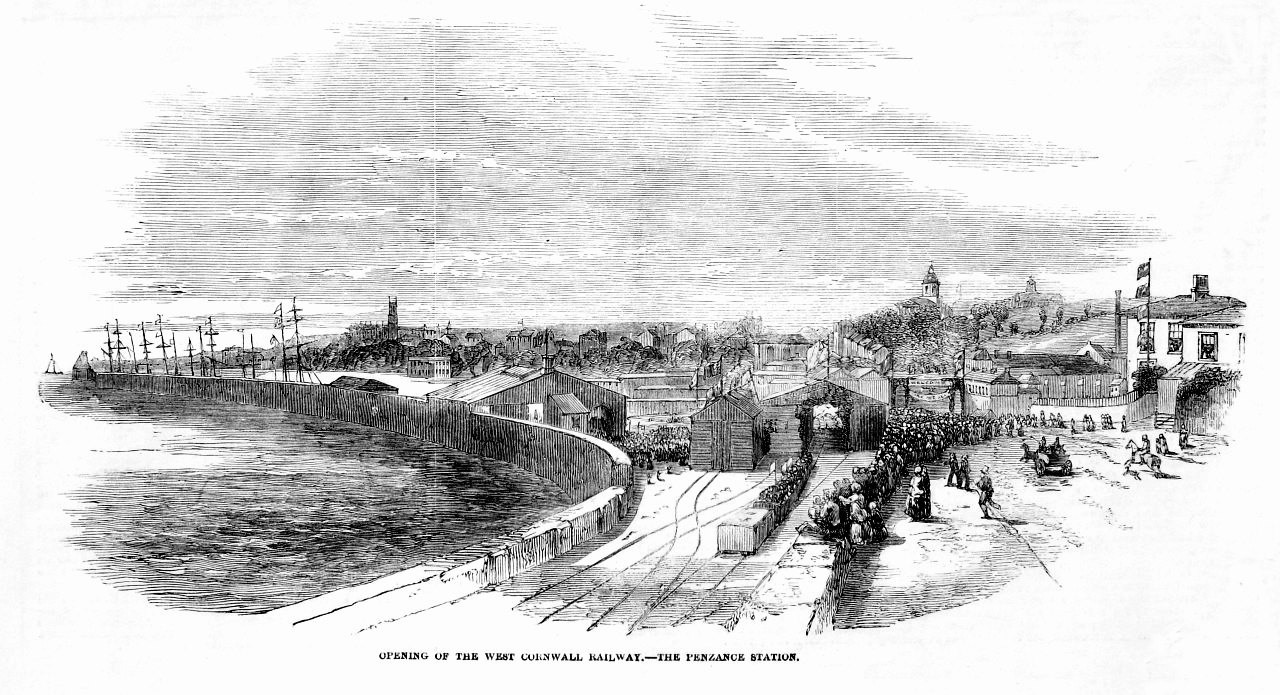
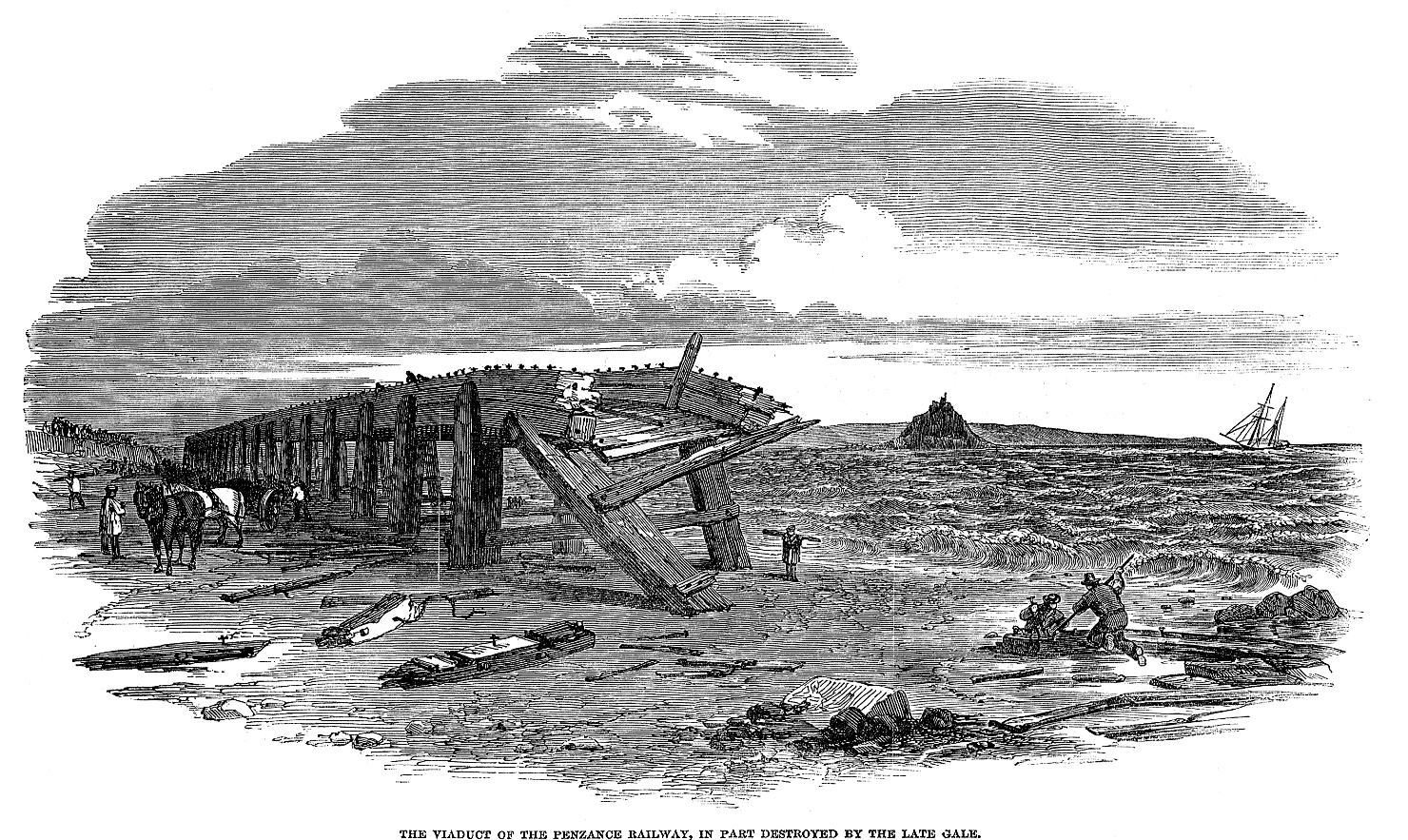
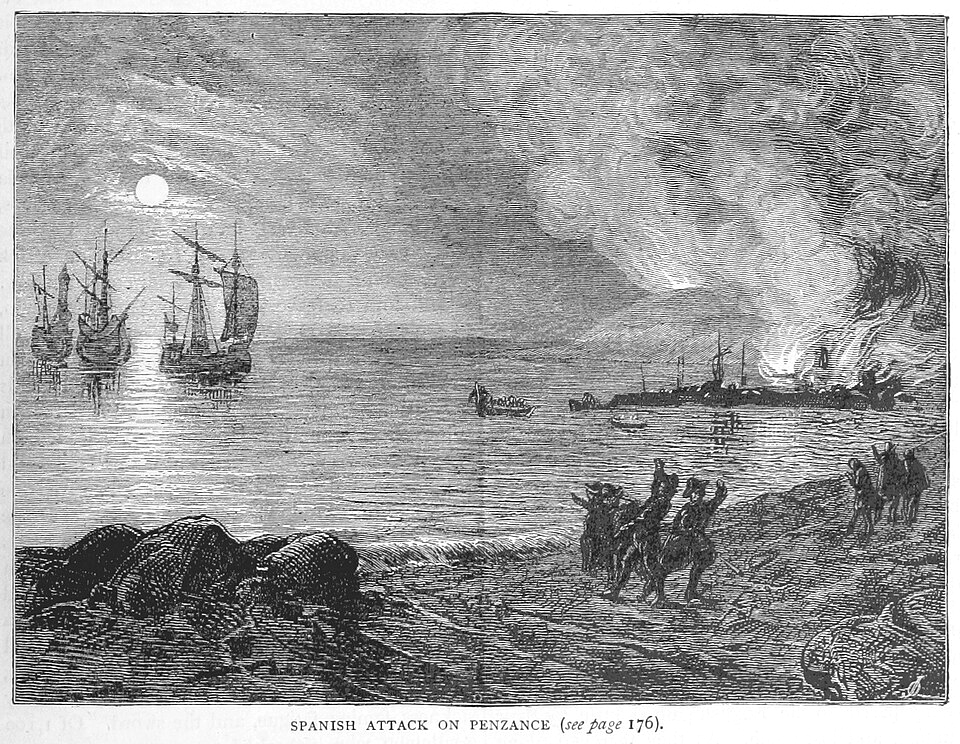
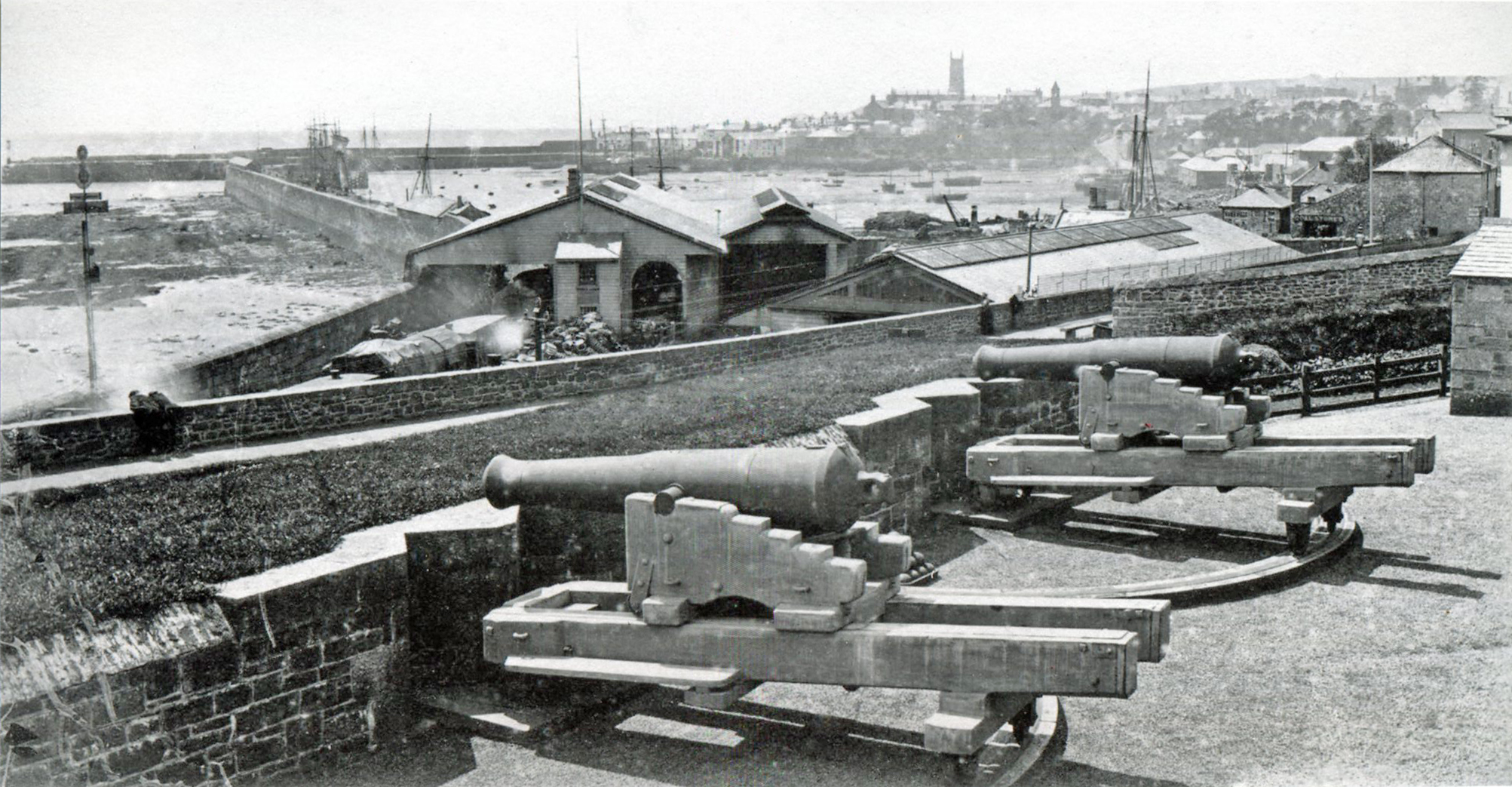

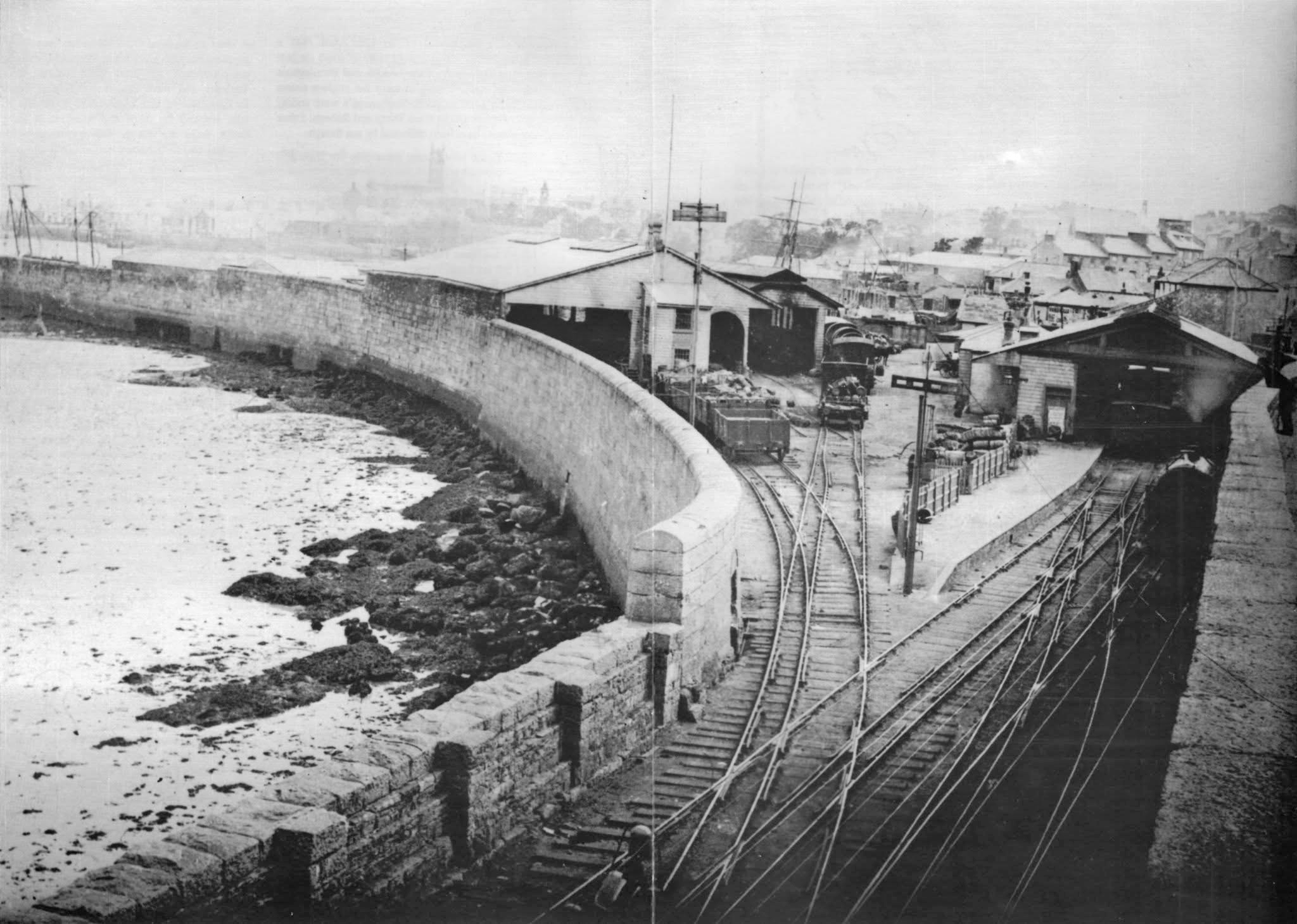
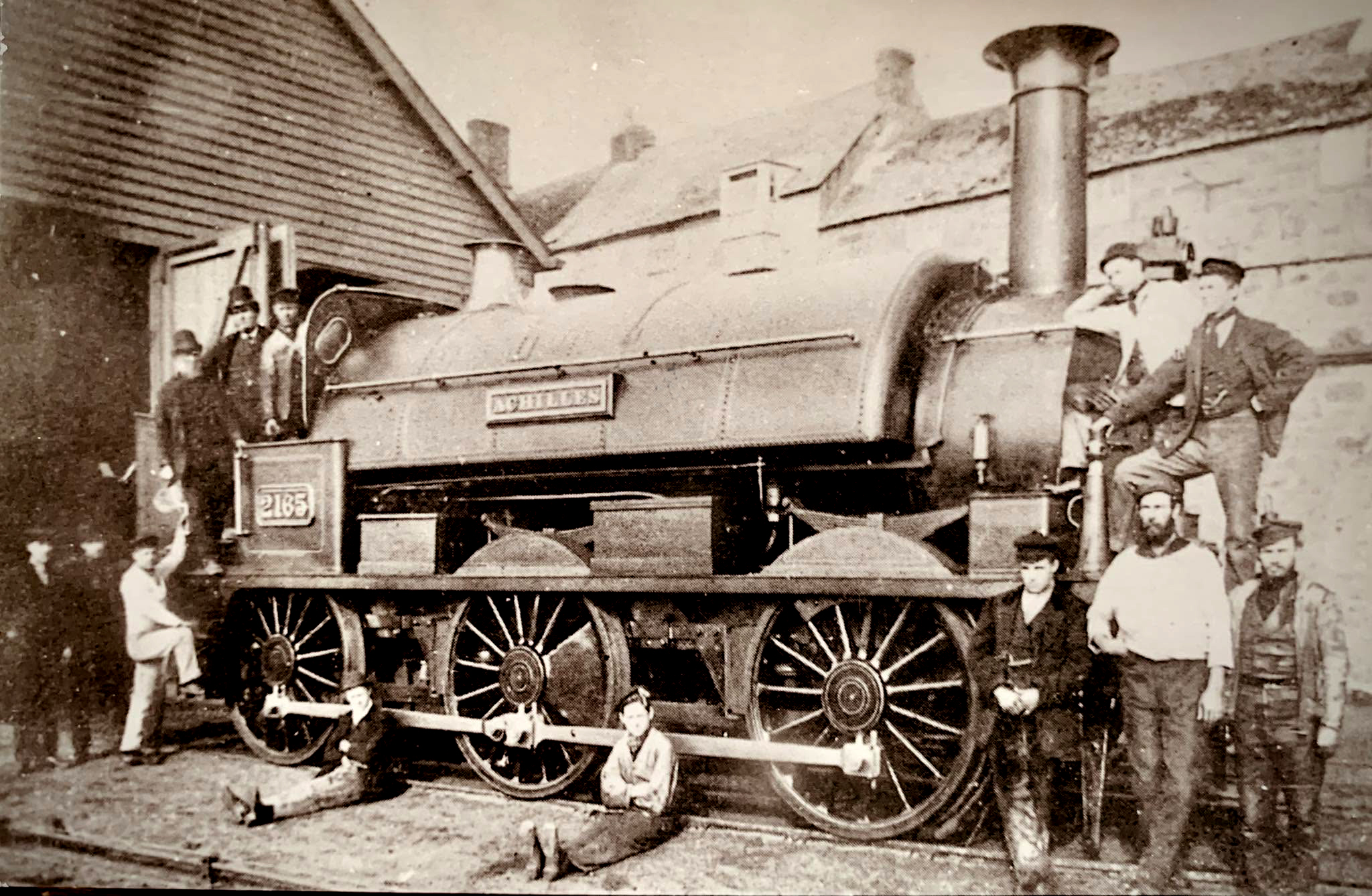

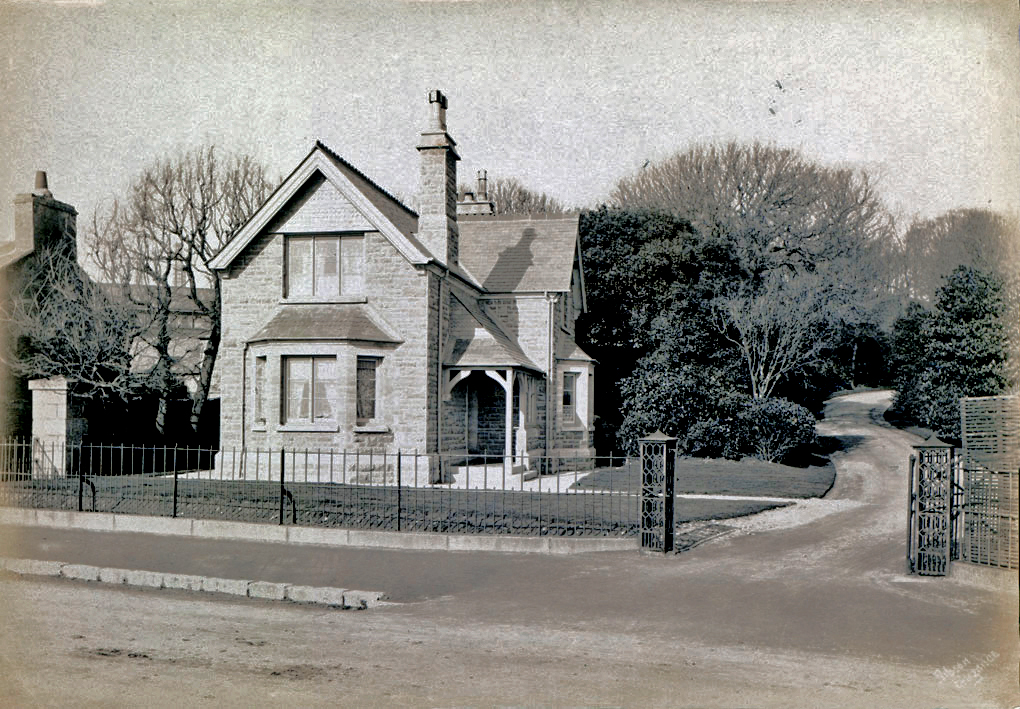





Bolitho Estate Office in Chyandour was built as a 'counting house', and stands as
testament to those days when carts laden with tin would arrive at the
counting house in Chyandour Square. The building also performed the function of a
bank, sometimes providing loans, eventually leading to the formation of
the Bolitho, Williams, Foster, Coode, Grylls & Co. Limited (Consolidated Bank of Cornwall).






Changes in Chyandour Square
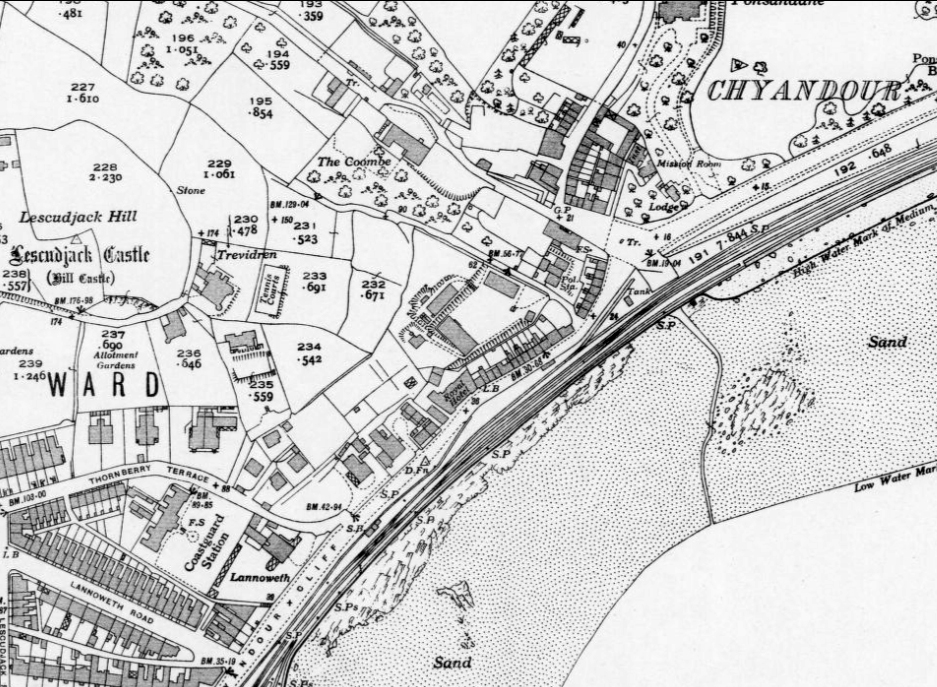
According to old Ordnance Survey maps, the two buildings at the back of the square were once an 'Institute' and a 'Mission Room', but by the mid-1960's the Institute had become a Kingdom Hall.Acknowledgements:
Grateful thanks to Dave Puddifoot, Steve Prescott, Jonathan Symons, Jonathan Warner and Pat Ayotte for sharing images with me.
..........................................................................................................................................................................................
Links:
Alverton: West of Penzance (a history) https://paulmason.info/Alverton/history.html
History of Old Hayle https://paulmason.info/Hayle/Hayle.html